
Genie Garage Door Repair in Canton: A Homeowner’s Guide
If your Genie opener blinks five times and stops, you’re not looking at a sensor problem. You’re looking at a logic board communication fault that most general repair techs will misread as a sensor alignment issue and charge you for the wrong fix. In Canton, where the garages tend to be tight and the doors get a real workout through humid summers and cold snaps, Genie units fail in ways that don’t follow the same rules as the brands most techs cut their teeth on. This guide translates Genie’s odd behavior into plain answers.
If you’d rather not spend your afternoon counting blinks and guessing, call (877) 358-2572. We already know your system.
What Do Genie Blink Codes Actually Mean?
Genie blink codes are the opener’s way of telling you which part of the chain of control has failed: the safety sensors, the travel limits, the force setting, or the logic board. The count and the color of the LED matter, and the same number can mean different things depending on which model you own. That’s the first place generalists go sideways.
Here’s how the patterns read on the three most common Genie families in Canton:
- ChainGlide (older chain-drive units): A five-blink pattern usually points to a motor or logic board communication fault, not a sensor. Two blinks on these units more often means the door hit an obstruction or the force setting is too tight.
- SilentMax (belt-drive, quieter): Repeated blinks without a full stop typically trace to a limit switch that’s drifted out of position. These units age into travel-limit problems more than sensor problems.
- Excelerator (screw-drive): Flashing that won’t clear after a power cycle usually means the encoder or logic board, not the sensors. The screw-drive mechanism itself is unusually durable; the electronics are where these give out.
A quick way to narrow it down: disconnect the opener from the door and run it with no load. If the same blink returns, the problem is in the unit. If it clears, you’ve got a balance or travel issue. Either way, if you’re staring at a logic board fault on a Genie, that’s not a sensor you can nudge into alignment. In Canton, getting an accurate Genie diagnosis the first time saves a return trip and a second invoice.
How Do Intellicode and Aladdin Connect Interact With Third-Party Sensors?
Intellicode is Genie’s rolling-code security system, and Aladdin Connect is its smart-home module that lets you control and monitor the door from your phone. Both are reliable when they’re set up right. Where things go wrong is when you mix Genie’s opener with aftermarket sensors, universal remotes, or a home automation setup that wasn’t built for Genie’s signal logic.
What we see in Canton homes most often:
- Universal remotes and keypads that advertise Genie compatibility but can’t hold the rolling code cleanly, causing intermittent “dead” remotes that get blamed on the opener.
- Aladdin Connect modules that drop off the home Wi-Fi after a router change and make the door appear unresponsive when it’s actually just offline.
- Third-party safety sensors wired in as replacements that don’t match Intellicode’s signal timing, producing phantom faults.
- Parallel sensor conflicts when two obstacles sensors are aimed at each other across the opening from mismatched brands.
The fix is usually simpler than it looks once you know the opener wants Genie-spec components and a stable Wi-Fi signal. If your smart features have gone quiet and the door still works, that’s an easy one to sort out before it becomes a bigger repair. Our garage door opener repair team handles Aladdin Connect and Intellicode issues regularly.
What Breaks First on a Genie: By Model Age
Genie openers fail in predictable order, and the age of the unit tells you a lot about what to expect before anyone opens the housing. Knowing the pattern keeps you from paying for a part you didn’t need.
On a unit around five years old: The mechanical side is usually still sound. What shows up first are remote and keypad battery issues, sensor alignment knocked slightly off, and travel limits that drift with the seasons. Canton’s humidity swings can move a door’s balance just enough to make the opener think it’s fighting an obstruction. Most of these are adjustments, not parts.
On a unit closer to twelve years old: The wear shows up in the logic board, the motor capacitor, and the gear assembly. On belt and screw drives, the board is the frequent failure; on chain drives, the gears and the capacitor. A twelve-year-old Genie with a dead board and worn gears is at the point where you’re weighing one meaningful repair against putting that money into a new unit. The decision usually comes down to what the logic board costs versus a new opener.
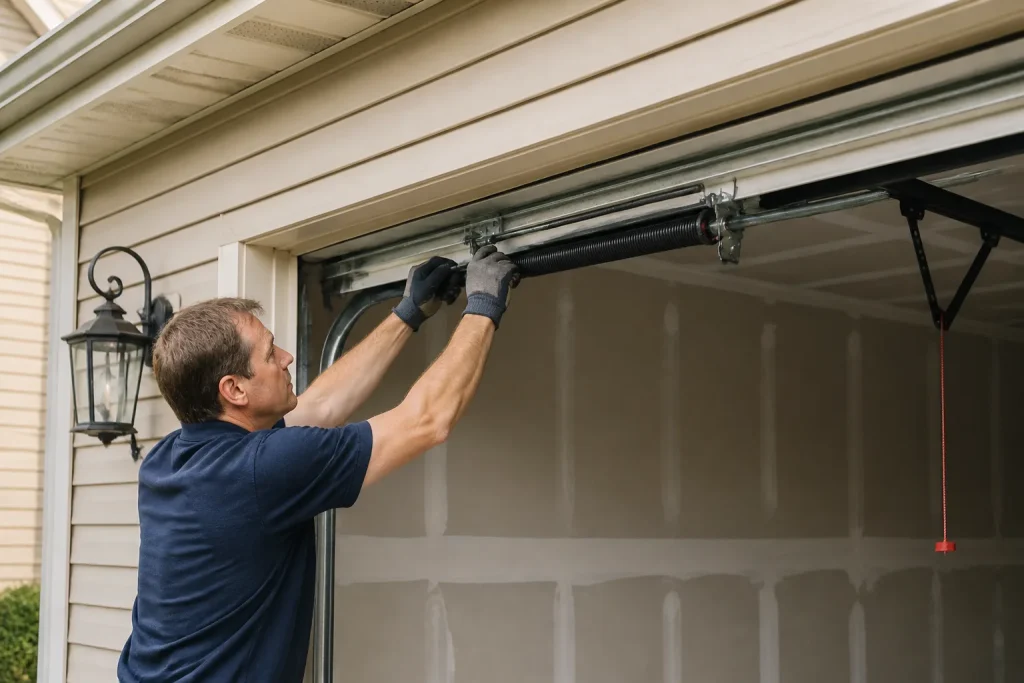
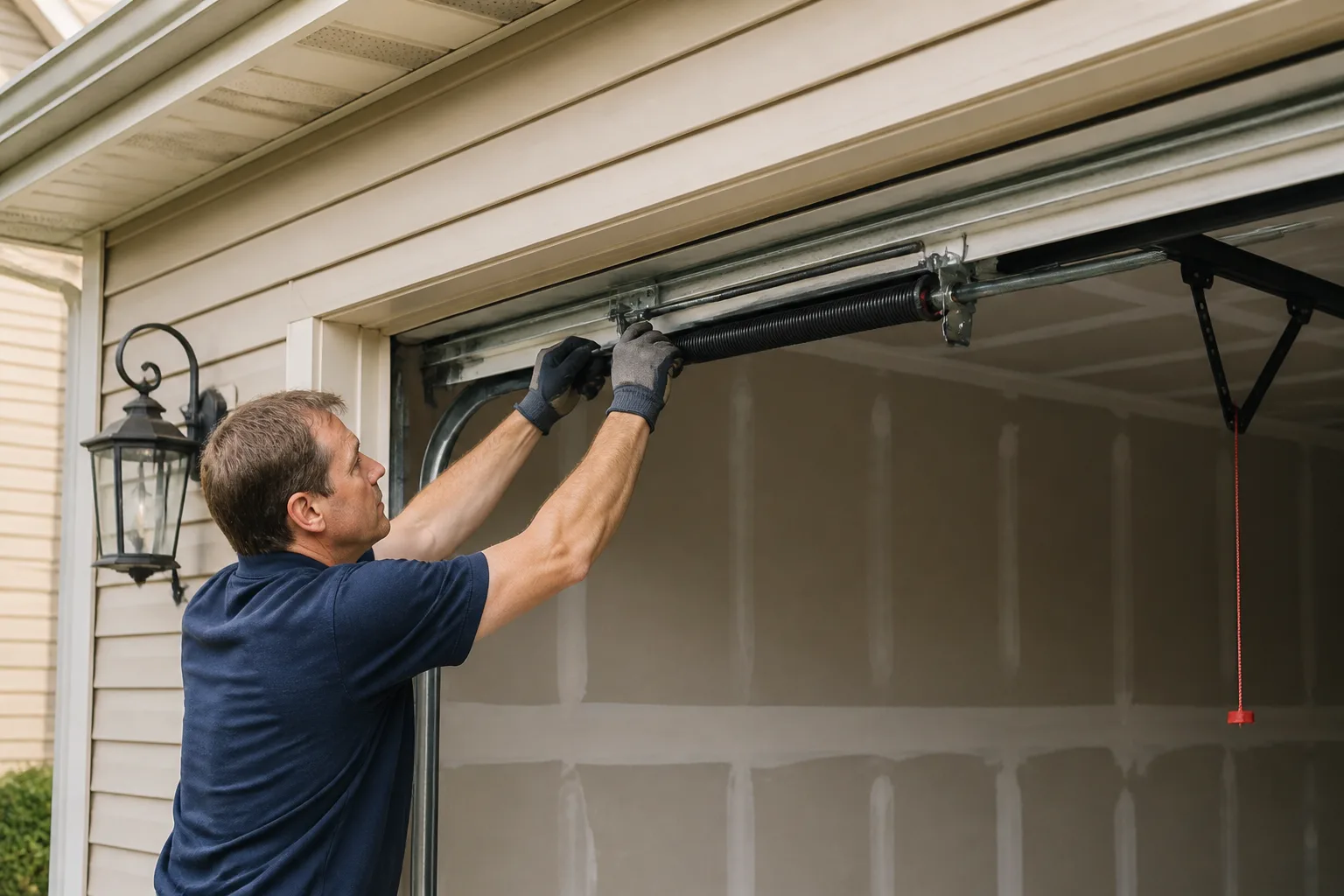
One reminder worth stating: the springs above the door carry the door’s weight and are under serious tension. Never adjust springs yourself. That work belongs to a trained technician, full stop. Our garage door repair team handles the opener side and the spring side in one visit.
Part Sourcing for Genie in the Baltimore Market
Not every Genie part is sitting on a shelf in the Baltimore area. Common items like safety sensors, remotes, keypads, capacitor replacements, and travel-limit switches are widely available and typically in stock locally. Logic boards, encoder assemblies, and model-specific belt or screw components are a different story: some of those require ordering and can carry a three-to-five-day lead time depending on the model year.
That lead time matters less on a non-urgent repair and more when your car is trapped and Canton schools start in the morning. Here’s how we approach it:
- Stocked locally: sensors, remotes, keypads, capacitors, limit switches, common hardware.
- Ordered, three-to-five-day lead time: logic boards for specific model years, encoder assemblies, some screw and belt components.
- Replacement-considering: when a board for an older Genie has to be ordered at a cost near a new opener, we tell you plainly rather than upselling.
When a Genie part needs ordering, we give you a written estimate up front so there are no surprises when the part lands. The right fix, not the easiest upsell, is how we work.
When Is a Genie Repair Worth It vs. Replacing the Unit?
A Genie repair is worth the investment when the unit is under roughly ten years old and the fault is a mechanical or electronic component you can replace without touching the motor or frame. It’s usually time to replace when the logic board, motor, and gear assembly have all come due on an older unit at the same time and the repair cost starts approaching the price of a new, quieter opener. Replacement is also worth weighing if you’re chasing smart-home features your current unit can’t support.
A few questions that settle it fast:
- Is the motor still strong? A struggling motor on an aging unit points toward replacement.
- Do the springs, panels, and tracks need work too? If the whole system is tired, a fresh opener on worn hardware rarely satisfies.
- Would newer quiet belt-drive tech matter for a bedroom over the garage? In Canton’s tighter lots, that’s often a real upgrade.
If replacement is the honest answer, we guide you through options from Genie, Chamberlain, Clopay, and Amarr so the new system fits the door you already have. That’s part of our garage door installation work.
When to Call a Pro
Call a professional when you’re facing a logic board fault, anything involving the springs or cables, a door that’s come off its track, or a Genie that keeps returning the same blink code after a reset. These are the jobs where a wrong guess costs more than a proper diagnosis. If it’s after dark or on a Saturday and the door won’t budge, the line is open: we answer 24/7, and fast dispatch runs from 7am to 7pm, Sunday through Friday.
Related services in Canton: opener repair, spring repair, panel installation, and full replacements, all from a single company. You can read more about how we take on the full job spectrum at Canton Garage Door Repair Pros.
The Bottom Line
Genie openers are good, hardworking units, but their error codes and limit-switch logic don’t line up with the brands most techs see every day. That mismatch is exactly why so many Genie problems in Canton get misdiagnosed as sensor issues when the real fault is a board, a travel limit, or a worn component. Know the model family, read the blink pattern against it, and decide repair versus replace on the age of the wear parts rather than the age of the door. Our technicians have up to 8 years of experience across Genie, Chamberlain, and the other major platforms, and the written estimate sets the price before any work starts.
If you’re in Canton and need help, Canton Garage Door Repair Pros offers free estimates. Call (877) 358-2572. Estimates are free, and we answer 24/7.
Frequently Asked Questions
On most Genie units a five-blink pattern signals a motor or logic board communication fault, not a safety sensor problem. A generalist may mistake it for sensor misalignment and charge for the wrong repair. Call (877) 358-2572 for an exact quote on diagnosis, and estimates are free.
Cost depends on the fault: sensor, remote, or limit-switch fixes sit at the low end, while a logic board or encoder repair runs higher, and the part’s model-year cost drives the estimate. The written estimate sets the final price before any work starts. Call (877) 358-2572 for an exact quote, estimates are free.
Same-day service is often available for Genie opener faults across Canton. We answer 24/7, and fast dispatch runs from 7am to 7pm, Sunday through Friday. Call (877) 358-2572, and remember the price is quoted and agreed before any work begins.
The local professional we connect you with is licensed and insured as their state requires, with background in Genie, Chamberlain, and other major brands. Call (877) 358-2572 to get scheduled, and estimates are free.
Written by the team at Canton Garage Door Repair Pros.
Need Garage Door Help?
Call Canton Garage Door Repair Pros - the local pro we connect you with is licensed and insured, here with fast help in Canton.
(877) 358-2572